
'We have not seen even during Vajpayee's time what Modi and the BJP has adopted now.'

'Modi's promise of change during the election campaign was on the domestic front, but his first year in office focused on foreign policy beyond all expectations,' says Ambassador T P Sreenivasan.
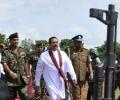
'Sri Lanka has a large military presence in the north and east, where it is very difficult for the war-affected civilian population to move forward.' 'Right now the military is doing jobs that should be for the civilians. I would like to see Sirisena consider demilitarisation.'

'We want to provide data, we want to provide consultation, but we don't want to lecture.' 'The consciousness about this issue in India is starting to get quite high and if we can help contribute to solving this air quality issue in a spirit of partnership with the Indians, it would be a big achievement.'
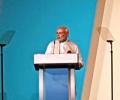
"In the flux and transition of our times, the most critical need in this region is to uphold and strengthen the rules and norms that must define our collective behaviour," he said.

'If prices of everyday consumption don't come down, employment doesn't pick up, 2020 will not be a happy year for anyone but the super rich,' notes Sherna Gandhy.

How to deal with a country that has made export of terror a reason to make the world notice and fund it? Rediff.com contributor Sanjeev Nayyar offers a few suggestions

Pakistani media on Monday termed the first meeting between Prime Minister Manmohan Singh and Nawaz Sharif as a "minor miracle" and noted that the dialogue held amidst a tense atmosphere yielded "words" but "no action".

'India has to judge what Pakistan says to us, not what they say to a domestic audience,' a source tells Sheela Bhatt/Rediff.com, explaining why India-Pakistan talks remain on track despite discordant noises from across the border.

'While military acts such as the Uri surgical strikes are one option, cultural, economic and diplomatic isolation should also be part of the arsenal,' argues Sankrant Sanu.

"We are committed to building a new India. We have to do this as early as possible," he said.

The Nobel follows a line of mighty brands that have bent low to kiss the feet of the popular, says Itu Chaudhuri.

Siva Sankar looks at S P Balasubrahmanyam's fantastic repertoire.
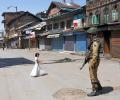
We must repeal AFSPA to begin to heal Kashmir, and to enhance India's moral stature and that of the army, says Ajai Shukla

'Vajpayee was the first prime minister to visit the battlefield at the height of conflict,' recalls Colonel Anil A Athale (retd).

'Civilian casualties are something that could change the mood overnight, and therefore should be avoided by every means.'

'We rarely choose to fight when the threat is still a nascent threat. When we do fight, we fight when the invaders reach Panipat and are preparing to knock on the gates of Delhi.'

It is important the SCO focus strongly on economic development and regional integration that leads to greater benefits for the least developed regions of member-countries, writes Sana Hashmi.

Talking about the threat of terrorism, he said "As diverse and pluralistic societies, we both face threats from fundamentalist terrorism. Yet, we do not seem to be able to cooperate as effectively we should in some critical international forums dealing with this subject."

'Today the Chinese think they can slap India, and there will be no consequences.' 'They must be made to feel the consequences through any and all means,' says Rajeev Srinivasan.

'Loss of faith in the fairness of the system and the perception that one cannot expect justice are the first few steps to the slippery slope of anarchy,' warns Colonel Anil A Athale (retd).

After days of speculation, Prime Minister Manmohan Singh confirmed he would meet his Pakistan counterpart Nawaz Sharif in New York, when he is expected to convey concerns over "barbaric" incidents on the LoC and continued terrorism emanating from Pakistan.
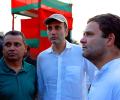
'It is the regional parties and their leaders who are the ones we have to watch.'

The climate conference on Saturday came out with an ambitious final draft that will commit USD 100 billion a year from 2020 to help developing countries.

'Modi's abject capitulation will play out badly in his core constituency.' 'The bulk of our strategic community is under the impression that India under Modi has already become a superpower.' 'They don't even want to look at the country's emaciated limbs or its asthmatic problems,' says Ambassador M K Bhadrakumar.
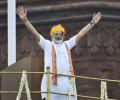
Following is the full text of Prime Minister Narendra Modi's address from the ramparts of the Red Fort on the 73rd Independence Day.

Immediately after India launched its surgical strikes, sources said, it had informed the US of its action.
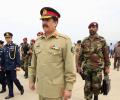
Nawaz Sharif may have permitted the trial of Jaish-e-Mohammed terrorists for the Pathankot attack. But this fell apart because of General Raheel Shareef's keenness to make Kulbhushan Jadhav the centerpiece of global attention. Ambassador G Parthasarthy, a former Indian high commissioner to Pakistan, reveals the Pakistan army chief's gambit against India.

'Pakistan has been successful in convincing the rest of the world that the Pakistani nuclear terrorists are meant to target only India. This is myopia at its worst,' says Colonel Anil A Athale (retd).
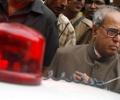
Coming down heavily on Pakistan, President Pranab Mukherjee has said unless it dismantles the terror infrastructure on its soil, there is no scope for progress in talks between the two countries.
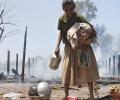
Hindu American Foundation: 'As an organisation that works on issues affecting Hindu minorities... in the civil war although all groups were affected, Hindu temples and Hindu institutions were disproportionately affected, and Hindus continue to be affected.' Sri Lanka's Ambassador to the United States Prasad Kariyawasam: 'Assume that Sri Lanka is referred to the ICC through the UN Security Council -- which will never happen because Sri Lanka has enough clout to block it. But assume it is. Still, the ICC cannot handle it because retrospectively they don't have jurisdiction.'

'The present government's greatest weakness is its intolerance. Tolerance is the key tenet of democracy. How can any government stop someone from speaking one's mind?'

The clichd path of conducting 'uninterrupted and uninterruptable' bilateral dialogue with Pakistan to improve ties remains unimplemented and un-implementable under prevailing circumstances that are unlikely to alter in the near future, says Rahul Bedi.

'A fierce crusader against communalism, George joined hands with majoritarian forces, never to revisit or re-assess his saffron association.' 'He was a Union minister in 1998-2004, a time when people like Graham Staines were lynched in Orissa.' 'On the Gujarat pogrom of 2002, George went on to kind of justify the slashing of pregnant women, by saying in the Lok Sabha that this was nothing new for India.' 'Thus, he was in sharp contrast to what he had himself stood for in the heyday of his political career in the 1970s and 1980s, says Mohammad Sajjad.

'India's military posture has become significantly stronger than China's on the 3,500-kilometre Line of Actual Control.' 'This is enhancing confrontation between the two sides,' points out Ajai Shukla.

'This is the first time that the Americans have agreed to refer to "cross-border terrorist attacks" in a joint statement.' 'No wonder Pakistan has called the joint statement "singularly unhelpful" and has blasted it, and its all-weather friend China has applauded Pakistan's frontline role in combating terrorism,' points out former foreign secretary Ambassador Kanwal Sibal.
Zakir Naik, a gentle, rockstar televangelist, is dangerous as young Muslims may be swayed by his fundamentalist interpretations of Islam and justify victimhood and extremism, says Shekhar Gupta.

A soldier cannot justifiably demand faster, easier promotions based on frequent field tenures

'If chutzpah nationalists brought the Babri Masjid down, chutzpah secularists did precious little to stop it from being torn down.' 'If chutzpah nationalists ensured carnage in Gujarat, chutzpah secularists allowed Muzaffarnagar to become their next hunting ground.' 'Chutzpah secularists readily banned SIMI, but dragged their feet when it came to banning the Bajrang Dal.'

The two countries also asked all nations to stop cross-border movement of terrorists and asserted that a decisive collective response from the international community without 'double standards and selectivity' was required to combat the threat of terrorism.
 © 2026 Rediff.com - Advertise with us - Disclaimer - Privacy Policy - Sitemap - Feedback - About us - Terms of use - Grievances